Fire, Arrested in Motion
Obsidian is usually called a stone, and it is not one. It is a natural glass – the only glass the earth makes in quantity without a furnace or a human hand. It forms when silica-rich lava cools so quickly that its atoms never find time to arrange themselves into crystals. Most rock is crystalline, built on an ordered internal lattice. Obsidian is frozen mid-motion, its structure locked in the disordered state of a liquid the instant before it would have become solid. That is the source of everything unusual about it: the depth, the lustre, the way a polished surface seems to hold light rather than reflect it. In the most literal sense, obsidian is fire arrested in motion.
The lava responsible is usually rhyolitic – thick, sluggish, and unusually rich in silica. As it reaches the surface and sheds its volatile gases, it grows so viscous that crystallisation becomes almost impossible. Rather than setting into the familiar granular texture of most volcanic rock, it hardens into a dense, smooth glass. This is why polished obsidian can appear, disconcertingly, blacker than black: there is no crystalline structure inside it to scatter or interrupt the light. What enters the surface is not thrown back at the eye. It sinks.
Not One Colour, but a Family
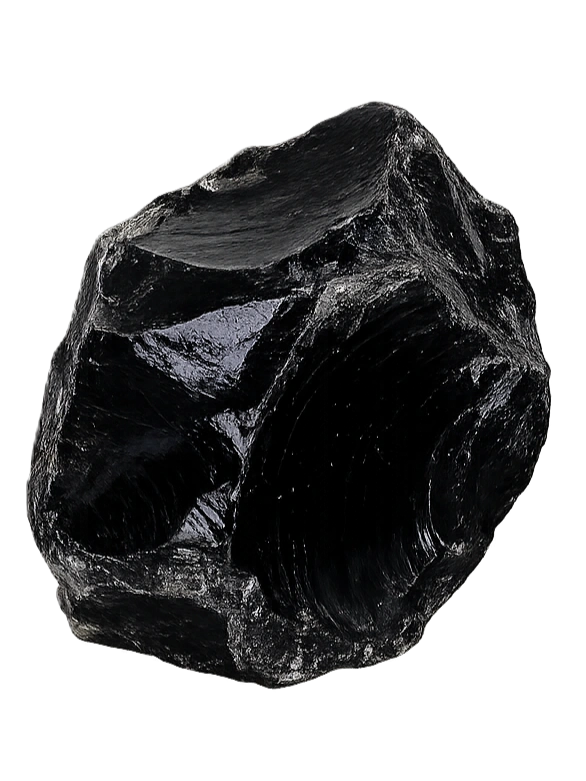
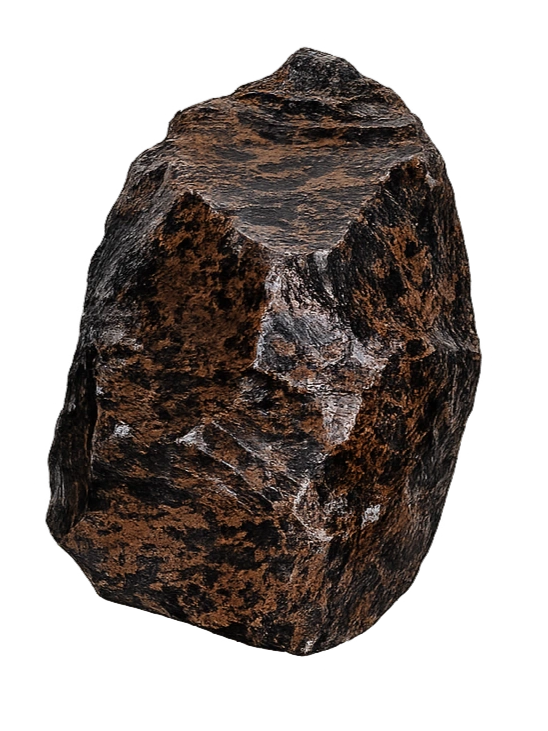
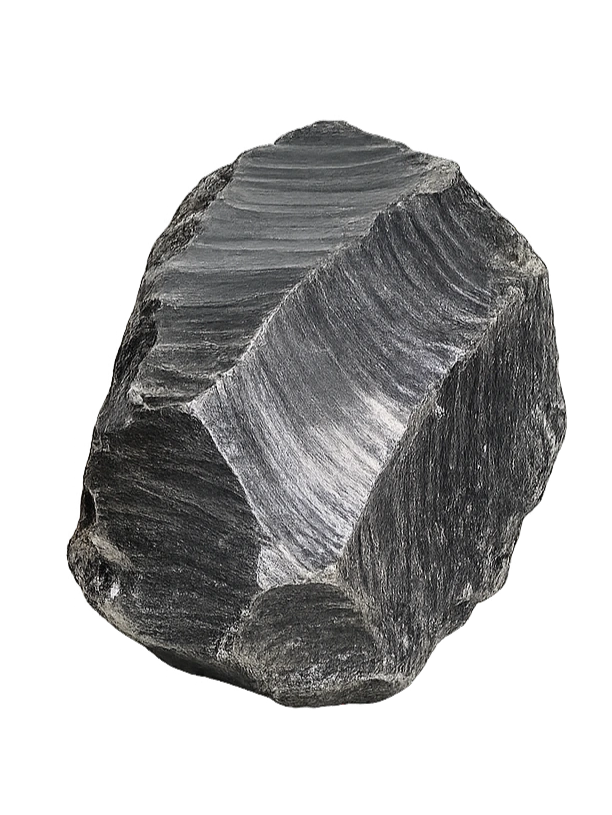
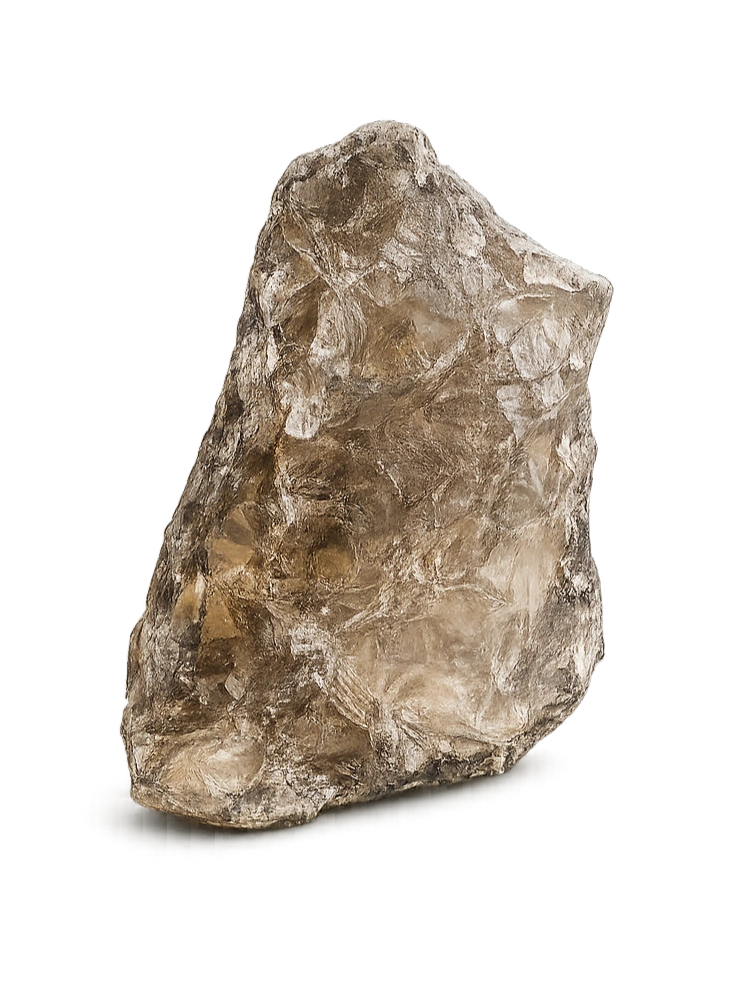
The popular image of obsidian is a slab of pure, glossy black. The reality is a whole family of volcanic glasses, and the variation within it is one of the material's quiet fascinations. Iron oxides can turn it brown, russet, or deep mahogany. Microscopic gas bubbles and half-formed crystallites – too small to break the glass, large enough to catch light – can lay a golden or silver sheen across the surface, visible only at certain angles. Cut thinly, or seen at its edges, some obsidian turns unexpectedly translucent, revealing that its darkness was never pigment at all but optical depth: an accumulation of light travelling into the glass and slowly giving out.
This is what separates obsidian from a merely dark stone. It does not sit at one colour. It absorbs, reflects, and refracts differently depending on the minerals suspended in it and the way it is cut and turned to the light. Two pieces from the same source, from blocks that lay yards apart, can look like entirely different materials. The colour is not applied to obsidian. It is a property of how each piece was made by the earth.
The Sharpest Edge in Nature
Obsidian has one further property that shaped its entire history: the way it breaks. Like flint and like manufactured glass, it fractures conchoidally – in smooth, curved surfaces rather than along flat planes. Where two of those fracture surfaces meet, they produce an edge of a fineness no metal can match.
The numbers are startling. A well-struck obsidian edge can taper to roughly three nanometres – about thirty angstroms – where the finest steel surgical blades measure in the hundreds. Under an electron microscope a steel scalpel's edge looks like a ragged mountain range; an obsidian edge appears continuous and smooth, fine enough to part tissue between individual cells rather than tearing through them. This is not folklore. A peer-reviewed study in the American Journal of Surgery in 1993 found that incisions made with obsidian healed with fewer inflammatory cells and narrower early scarring than those made with steel, and a small number of surgeons still reach for obsidian blades in procedures where minimal trauma matters most.
None of this was known to the people who first valued the material – but they understood its consequence perfectly. For most of human history, obsidian was not decorative. It was technological: the finest cutting material available, worked into blades, scrapers, arrowheads, and ritual objects. In some cultures it was ground into mirrors, and so acquired a second life bound up with reflection, ceremony, and status. Long before it was beautiful to us, it was useful – extraordinarily, unmatchably useful.
Obsidian, almost uniquely among materials, carries its provenance inside its own chemistry.
A Material with Provenance in Its Chemistry
Obsidian does not occur everywhere. It belongs to volcanic landscapes, to the specific places where the right lava chemistry met the right cooling conditions – Iceland, the Aeolian Islands off Italy, Yellowstone, parts of Anatolia, the Caucasus. And because each obsidian forms in a particular volcanic event, individual sources carry distinct chemical signatures, like fingerprints written in trace elements.
This has a remarkable consequence. An archaeologist can take a worked obsidian tool, measure its trace-element composition, and identify the very volcano it came from – sometimes a single lava flow within that volcano. Obsidian, almost uniquely among materials, carries its provenance inside its own chemistry. It cannot be faked, and it cannot be mistaken for stone from elsewhere. Where it came from is written into what it is.
The Armenian Highlands
Nowhere is this history richer than in the Armenian Highlands. The wider South Caucasus is one of the great obsidian landscapes of the world, its volcanic centres – among them Arteni, Gutansar, Hatis, and the Gegham range – yielding obsidian in a variety few regions can equal. In prehistoric Armenia this was no marginal material. It was central. Across countless archaeological sites in the region, obsidian dominates the stone tools recovered, and some of it is astonishingly old: worked obsidian associated with the earliest human presence in the Highlands has been dated to more than a million years, and the great source at Arteni has yielded material worked across an almost unbroken span from the Palaeolithic to the Bronze Age.
What lifts Armenian obsidian beyond the geologically impressive is that it travelled. Scientific sourcing studies have traced obsidian from the Armenian Highlands to sites hundreds of kilometres away – Armenian glass has been identified at Late Neolithic settlements in northern Mesopotamia, carried across enormous distances by people with no wheel and no beast of burden. It was, in other words, worth the journey. It moved along some of the earliest exchange networks known to archaeology, desirable enough to be traded far from the volcanoes that made it. That is a rare thing to be able to say of a raw material: that thousands of years ago, people who had almost nothing chose to carry it a very long way.
This is the character that sets the Armenian stone apart. It is not only dramatic in its geology; it is resonant in its history – a material drawn from a landscape where volcanoes, highlands, ancient craft, and deep archaeology all meet. There is a particular kind of continuity in taking a glass once knapped into blades and ritual mirrors and shaping it, now, into objects made to be lived with. Not imitation – the forms are entirely of our time – but a kind of respect for how seriously the material has always been taken.
The Five Natural Varieties
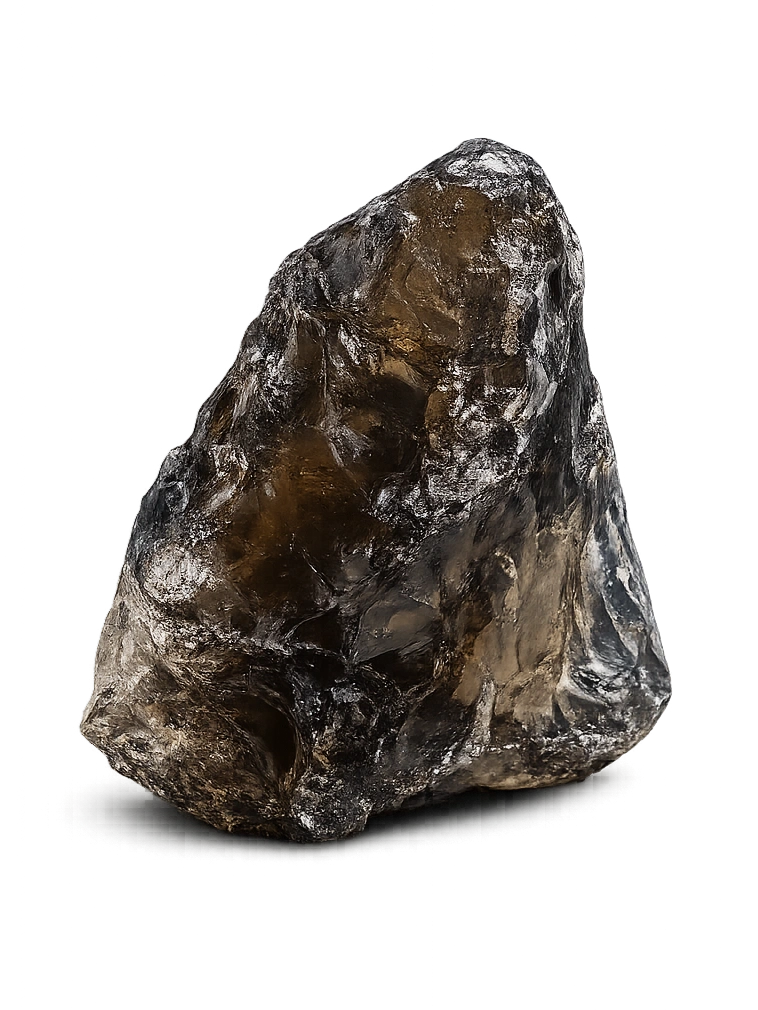
The Armenian Highlands yield a range of natural obsidian varieties, shaped by differences in mineral content, cooling conditions, and geological formation within the same volcanic region – from absolute black to patterned, reflective, and light-responsive forms.
The Character of the Finished Stone
Worked and polished rather than fractured, obsidian reveals a different set of qualities. It rates between 5 and 5.5 on the Mohs scale – harder than window glass, close to a steel blade, softer than quartz – hard enough to resist the ordinary abrasions of a life among other objects. Its surface is non-porous: it absorbs nothing, harbours nothing, does not tarnish or oxidise or react. Kept with a little care, an obsidian object does not age the way most things age. It accumulates use – the faint warmth of something handled often – without wearing down.
In the hand it is unmistakable. Polished obsidian is not slick in the way manufactured glass is slick; it has a density, a slight resistance, a temperature that settles to the skin. It communicates its own weight. And it carries, beneath the polish, the whole of what it is: a volcanic glass with the permanence of stone and the optical depth of water, at once among the most ancient materials worked by human hands and one of the most strikingly contemporary – severe, sculptural, restrained, and never quite still.